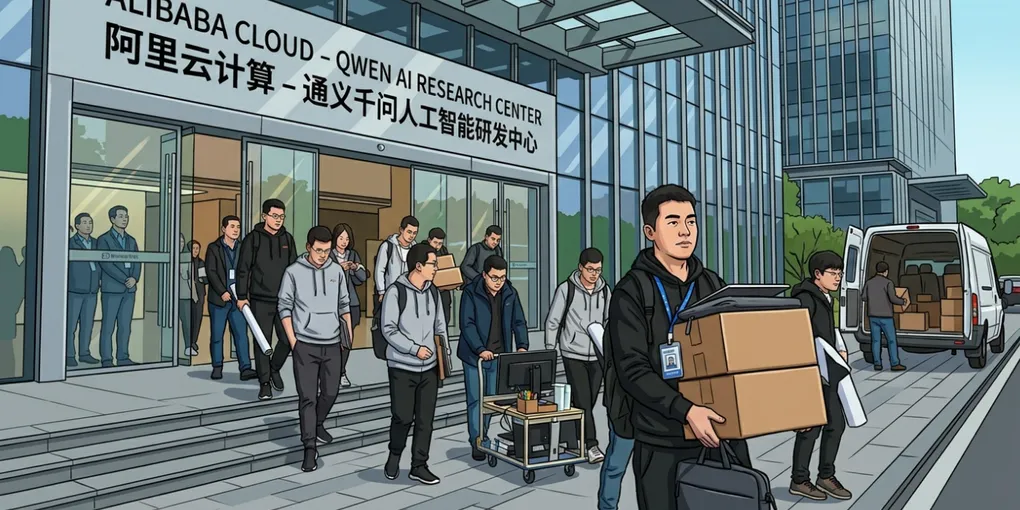
Inside the Qwen Exodus: How Alibaba Lost Its AI Dream Team
On March 2nd, 2025, Alibaba’s Qwen team dropped four open-weight small models that broke the internet. The open-source community celebrated. Even Elon Musk took notice, calling it “amazing intelligent density” on X. It seemed like Qwen was finally coming for everyone.
The same day, Alibaba launched a $3 monthly coding plan for international users—an aggressive move that looked like the culmination of years of work. But within hours, they scaled it back. Something was already off.
Twelve hours later, the man who built all of it was gone. And then his entire leadership team followed.
The Night Everything Changed
At 1:00 a.m. Beijing time on March 4th, Lin Janjiang, technical director of Qwen and one of Alibaba’s youngest ever top-ranked engineers, posted his resignation on X. No warning. No transition plan. Just gone.
Within hours, the head of Qwen Code, Qwen Post-training, and Qwen VL all walked out with him. The open-source community went into shock. Someone posted that “Qwen is nothing without its people.” Everyone understood what that meant.
Who Is Lin Janjiang?
To understand why this hit so hard, you need to know who this guy is.
Lin Janjiang took over Qwen in 2022. Born in 1993, he turned it into the dominant open-source model family in the world. Over 400 models released in three years. Every single one of them covered on tech channels worldwide.
He did this with a team of just over 100 people. For comparison, ByteDance’s model team has nearly 2,000 engineers. Alibaba was outgunned on every resource metric—and still kept pace at the frontier.
Multiple sources inside Alibaba told me this was almost entirely down to him. One senior engineer, still there, told me directly: he is a talent worth more than $100 million.
The Real Problem: Compute Starvation
At 1:00 p.m. on March 4th, Alibaba’s CEO Wu Jong Ming walked into an emergency all-hands meeting with the Qwen team. His opening line: “I should have known about this sooner.”
Here’s what my source told me directly: the real problem was that external customers got smoother compute access than the team building their flagship model. When your own cloud cannot serve your own researchers, talent votes with their feet. And that’s exactly what happened.
Alibaba Cloud is one of the largest cloud providers in the world—a pretty good one. But the team building their most important AI model was getting less GPU access than paying outside customers.
The Qwen team came to that meeting with sharp questions on compute shortages, recruitment gaps, and restructuring decisions. Alibaba Cloud co-acknowledged the problem was real, said there were historical reasons for it, and offered no concrete fix.
Then the exits started.
Who Walked Out
The people who walked out with Lin Janjiang tell you how deep this goes:
- Bing Yuan — ran the entire Qwen Coder direction
- Bowen Yu — led post-training and built the Qwen Instruct series
- Kaisen Lee — core contributor to Qwen 3.5VL and Coder
Plus multiple younger researchers on the same day. These were not peripheral people. These were the people who actually built Qwen.
What Alibaba Is Saying vs. What’s Happening
The official line is that it was expansion, not contraction. Teams are being merged, given more resources, bigger ambitions. But the context destroys that framing.
Alibaba is losing the Chinese consumer AI war. ByteDance’s Doubao is closing in on 200 million daily active users. Alibaba’s Tongyi Qianwen (Tongyi app) has roughly one-tenth of that.
The pressure from the top is not to build the best open-source model in the world for free. It’s to win on daily active users. It’s to earn money—not from giving away models, but from their consumer products.
The person brought in to replace Lin Janjiang comes from Google DeepMind and reports directly to the cloud CTO. That reporting line tells you exactly where Qwen is headed.
The Big Concern
My fear is not about any person individually. It’s about what happens when a research-first team gets replaced by a product-metric team.
Because that transition has a predictable outcome: open releases get deprioritized, small models get dropped, and the community that built everything around those models gets left behind.
No other team was pushing quality this hard at the small end of the size range, this consistently, this openly. That pain is real.
A Final Note
A few hours after the all-hands, Lin Janjiang posted a message to his WeChat (not X): “Qwen’s brother continued to work according to the original arrangement. No problem.”
He didn’t burn anything down. He just told his people to keep going. That says everything about who he is.
There’s a lot of pressure and things happening in Beijing. Some government officials have gotten involved, trying to resolve matters amicably because AI is a big priority for China too. Whether he ultimately stays or leaves is still unresolved.
But the people who built Qwen with him have already left. The compute starvation, the resource gap, the consumer pivot, crushing research priorities—none of that has been fixed.
And until it is, Qwen as an open-source project the world fell in love with is in serious trouble.
This article was written based on content from: https://www.youtube.com/watch?v=6T5nRuG1Y5U